Website Redesign or Rebuild? A Decision Framework for 2026
Six signals that you genuinely need a rebuild, six that mean a redesign is enough, and the launch checklist that stops a cliff-edge drop in search traffic
Whether to rebuild an old website is not an aesthetic judgement but a structural one: an unsupported runtime, no responsive design, or lost admin control mean rebuild, while dated visuals or stale copy usually mean a redesign is cheaper and safer. This guide gives six paired signals, the five mechanisms behind post-launch traffic collapse and how to prevent each, a seven-question decision flow, and the three things to finish before any code is written.
Contents ▾
Your website was built in 2017. It breaks on phones, the admin password left with an intern, and the agency that built it no longer answers the phone. Do you patch it, or do you tear it down and start over?
This is the least-well-answered question in small-business web strategy, and the reason is structural: almost everyone who writes about it also sells rebuilds. So the conclusion is always the same. In reality, a rebuild is not automatically the better choice, and in a large share of cases a redesign is cheaper, faster, and materially less risky.
The problem for an owner is that you cannot easily tell whether a symptom is skin-deep or structural. A slow site might be a bloated image library or it might be an architecture that cannot be fixed. An ugly site might need a designer or it might need an engineer. Without a way to tell them apart, companies routinely spend rebuild money on redesign problems, and redesign money on sites whose foundation will force a rebuild two years later anyway.
This article gives you a framework you can walk through yourself, before you talk to any vendor. It covers four things: what redesign and rebuild actually differ on technically; six signals that you genuinely need a rebuild versus six that mean a redesign is enough; how the single biggest hidden risk — a cliff-edge drop in search traffic — actually happens and how to prevent it; and the three things you must complete before anyone writes a line of code. There are four tables you can print and take into the vendor meeting.
One disclosure on where this is written from: HappyCXO Studio helps small and mid-sized manufacturers and trading companies build export demand (about us). This article does not recommend rebuilding, and it does not recommend redesigning. The right answer depends on the state of your site, not on who is writing. If you are starting from nothing rather than replacing something, read the export website build guide instead.
Ask the right question first: redesign and rebuild differ on foundations, not budget
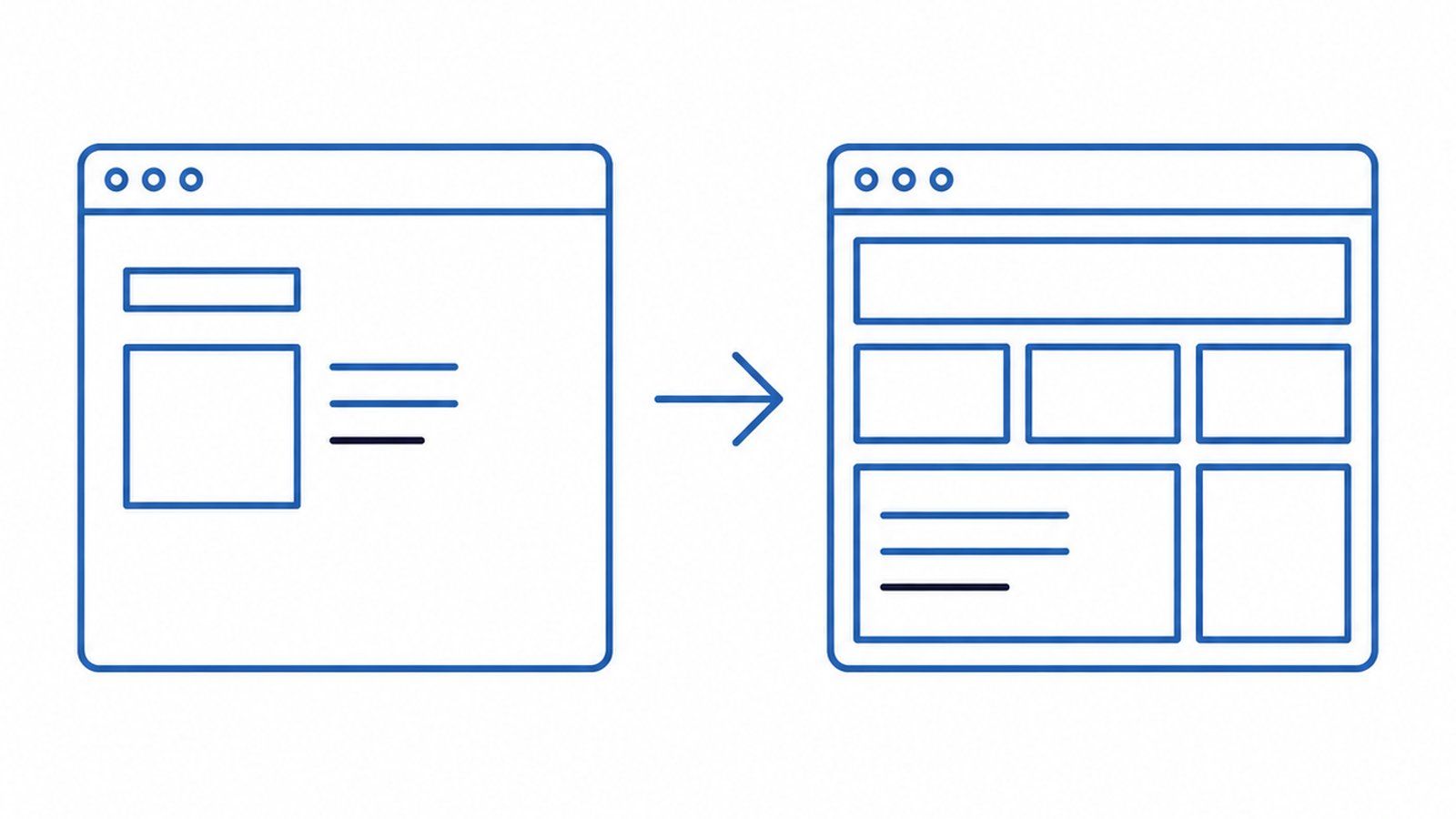
Direct answer: a redesign keeps the underlying system and replaces what sits on top of it. A rebuild replaces the underlying system, which makes it a site migration. The difference that matters is not the price tag — it is whether URLs and data structures change. Once they do, you are in a completely different risk class.
Think of it as the difference between renovating and rebuilding a house. A renovation changes floors, paint, furniture, maybe adds a room, but the structural beams, the plumbing, and the street address stay exactly where they were. A rebuild can change all three. The failure mode of a renovation is that you dislike the result. The failure mode of a rebuild is that the mail carrier can no longer find your house.
Technically, a redesign touches the theme or front-end templates, page layouts, copy and imagery, add-on functional modules, baseline SEO settings, and responsive breakpoints. All of that happens on top of the existing content management system. The database schema is untouched, and every page keeps its URL.
A rebuild touches the CMS or framework itself, the database schema, the hosting environment and language runtime, the permalink rules, and sometimes the domain. The moment any of those changes causes old URLs to stop existing, you have entered what Google formally calls a site move with URL changes — and Google states plainly that for a medium-sized site it can take a few weeks or more before new URLs start replacing old ones in results (Google Search Central: site moves with URL changes).
Here is the first myth worth killing: many owners assume a rebuild is safer because it is more thorough. The opposite is true. A redesign fails visibly and recoverably — it looks wrong, it is still slow. A rebuild fails invisibly and expensively — search engines stop finding you, nobody notices for a month, and the window for a clean fix is the first few weeks after launch. Your real cost was never the invoice. It also includes five years of accumulated rankings, every inbound link pointing at your old URLs, and the address sitting in a buyer bookmark.
There is also a third option almost nobody offers you, and it is frequently the best one: a rebuild that deliberately preserves the URL structure. You can replace the CMS, the host, and the entire front end while keeping every page at the address it already had. It is entirely feasible technically; it simply has to be written into the requirements before work starts, because it constrains how the new system names things. You get a modern foundation with near-zero migration risk. If your existing URLs are reasonably sane, this is usually the highest-return path. The requirements and acceptance checklist article shows how to write it into a contract.
Six signals you need a rebuild versus six that mean a redesign is enough
Direct answer: the test is whether the problem lives in the skeleton or the skin. Skeleton problems — an unsupported runtime, no genuine responsive design, lost administrative control, a data model that cannot stretch, unpatchable security — require a rebuild. Skin problems — dated visuals, stale copy, a missing feature module — do not, and typically cost a fraction of the price.
Signal one: the underlying technology is out of support. This is the hardest signal because it does not care about your preferences. WordPress currently recommends PHP 8.3 or greater, with MariaDB 10.11+ or MySQL 8.0+ (WordPress requirements). Meanwhile the PHP project shows that security support for PHP 8.1 ended on 31 December 2025, and security support for PHP 8.2 ends on 31 December 2026 (PHP supported versions). If your site runs on something older and breaks whenever you try to upgrade because a legacy theme or plugin is incompatible, that is not an upgrade problem. That is an expiry date.
Signal two: there is no genuine responsive design. The word genuine is doing real work there. Many sites built around 2015 have a separate mobile site with less content than the desktop version. Under mobile-first indexing that is now actively harmful, because Google states that only the content shown on the mobile site is used for indexing, and advises making mobile content equivalent to desktop (Google Search Central: mobile-first indexing). Traffic has followed: StatCounter data for August 2026 puts mobile at 49.36% of global web traffic against 49.11% for desktop and 1.54% for tablets (StatCounter). If your layout was built with fixed-pixel table structures, no amount of added CSS rescues it.
Signal three: you cannot get into the admin, or the original vendor is gone. This one is badly underrated. If you do not hold the source code, the hosting console, and the domain registrar login, what you own is not an asset — it is a rented property whose landlord has disappeared. Even a modest redesign becomes expensive because an engineer has to reverse-engineer the site first, and when it is done you still do not have control. The test is simple: could you, this afternoon, log in and download a complete backup yourself? If not, this signal applies.
Signal four: the data model cannot carry the new requirement. Typical shapes of this: you had fifty products and now have eight hundred, and buyers need to filter by material, application, and certification simultaneously; or you need real multilingual support but the old site implemented languages by duplicating entire page trees; or you want live inventory and lead times from your ERP and the old tables have no fields for them. No plugin solves these, because the problem is how data is stored, not how it is displayed.
Signal five: security cannot be patched. This risk is immediate rather than theoretical. A critical vulnerability in the widely used Elementor Pro plugin, CVE-2026-32475, was exploited on the same day it was disclosed; the security vendor Wordfence reported blocking more than 190,000 exploit attempts since disclosure, with attackers bypassing form upload checks to write executable PHP onto the server (iThome report). The fix was a plugin update. If your site is pinned to an old version because a legacy theme breaks on upgrade, you are the site without the patch. A separate disclosed flaw in the ACF Extended plugin, CVE-2025-14533, affected roughly 100,000 WordPress sites and allowed privilege escalation to administrator (iThome report). A site that cannot be updated is not merely old. It is exposed.
Signal six: core performance metrics fail and will not move. Google defines good Core Web Vitals as LCP within 2.5 seconds, INP under 200 milliseconds, and CLS below 0.1 (Google Search Central: Core Web Vitals). If you have already compressed images, enabled caching, and added a CDN, and LCP still lands at six seconds, the bottleneck is architectural — an overweight page builder, conflicting plugins, an underpowered shared host — and tuning parameters will not save it.
Now the six signals that mean a redesign is enough, where a rebuild is simply wasted money: dated visuals on a healthy structure; copy that needs rewriting, which is a content problem the old system can carry perfectly well; a few missing functional modules such as forms, language switching, product filtering, or a quote basket; slowness whose bottleneck is fixable, meaning uncompressed images, no caching, or a hosting plan that is too small; no baseline SEO configuration, all of which can be added in place; and a language that needs adding where the existing system supports standard multilingual tooling.
| Dimension | Rebuild signal | Redesign is enough |
|---|---|---|
| Runtime and CMS | Out of security support, upgrades break the site | Still supported, updates apply cleanly |
| Mobile | No responsive design, or a thinner separate mobile site | Responsive exists, layout is merely ugly |
| Control | No admin access, no source code, vendor unreachable | All credentials held, backups self-serve |
| Data model | Product count or filtering has outgrown the schema | Schema is adequate, presentation is weak |
| Security | Known vulnerabilities unpatchable due to compatibility | Core and plugins update normally |
| Performance | LCP far above 2.5s after basic optimization | Bottleneck is images, caching, or hosting tier |
| Visual and content | Not a rebuild reason on its own | Dated styling, stale copy, missing modules |
| Budget class | Approaches the cost of a new build | Roughly a third to a half of a rebuild |
| Dominant risk | URL and search-equity migration | Post-launch visual and compatibility tuning |
The summary of that table is short: if none of the six rebuild signals apply, what you need is a designer and a writer, not an engineering project. If three or more apply — especially unsupported technology combined with lost control — then any redesign is just deferring a bill you will still have to pay.
The hidden risk: how a redesign causes a cliff-edge traffic drop
Direct answer: traffic collapses after a relaunch almost never because the new site is worse. It collapses because old URLs disappeared and were not correctly redirected. Search engines drop the old pages within weeks while the new ones have no accumulated authority, and the gap between the two is the cliff. It is entirely preventable, but only before launch.
This is the section that earns the article, because it describes something that happens constantly and is almost never raised during a quote. The symptom pattern is consistent. Week one, everyone admires the new site. Weeks two to four, sales mention that inquiries feel quiet. Week six, someone opens the analytics and organic sessions are down by more than half. The vendor says search engines need time to re-index. That is half true, and it conceals the real cause.
Mechanism one: URLs changed and nothing redirects them. The old product page was one address, the new one is another, and the old one now returns a 404. Every ranking, every click-through history, and every inbound link that page had accumulated resets to zero. The inbound links hurt most: references from customer sites, trade media, and B2B directories now all point at pages that do not exist, and an entire backlink asset evaporates in one afternoon.
Mechanism two: a 302 was used instead of a 301. This is the most common implementation error, and its damage is underestimated precisely because it looks fine to a human — click the old link, land on the new page, sign off the acceptance test. But Google is explicit: with a permanent redirect (301 or 308), the indexing pipeline uses the redirect as a signal that the target should be canonical, whereas with a temporary redirect (302 or 307) the indexing pipeline does not use it as a canonical signal (Google Search Central: redirects and Google Search). A 302 tells Google to keep treating the old address as the real one — an address that now has no content on it.
Mechanism three: redirect chains. Sites that have been relaunched more than once accumulate hops: old URL to older URL to interim URL to current URL. Googlebot follows up to 10 hops, but Google advises keeping chains short — ideally no more than three and fewer than five — and redirecting straight to the final destination (Google Search Central). The same document carries a rule that is routinely missed: keep redirects in place as long as possible, generally at least one year. Plenty of second traffic collapses trace to redirect rules being wiped during a hosting change three months after launch, with nobody connecting the two events.
Mechanism four: the rewrite deleted the keywords that were ranking. This one is subtler. Suppose a specification page has quietly ranked on page two for years and produces steady inquiries. During the relaunch someone decides it reads too technical, rewrites it as brand narrative, and removes the spec table, the model numbers, and the application list. The URL never changed and the redirect is fine, but the ranking still falls, because the page no longer answers the query. URLs are the skeleton and content is the muscle. Both move rankings, and content usually has nobody guarding it.
Mechanism five: technical loose ends at launch. Three recur constantly: the sitemap still lists old URLs or was never resubmitted; the staging site got indexed because nobody password-protected it; and a site-wide noindex tag from development was never removed. The last one is fatal and completely invisible to a human reviewer — the site is simply gone from search. It appears far more often than anyone admits, because acceptance checklists rarely include it. The technical self-check article in this series walks through how to verify each one.
There is also a second-order effect worth naming. When traffic falls, your sales team does not know why — they only know inquiries dried up. So they push for more ad spend, more trade shows, more outbound headcount. That is real money spent papering over a technical hole that should have been closed before launch. The honest total cost of a badly executed migration is the project fee, plus six months of lost organic demand, plus the marketing spend bought to replace it — routinely far more than the migration planning that was skipped to save money.
Six actions that protect your traffic
Direct answer: protection takes six actions — build a one-to-one old-to-new URL map, use 301 rather than 302 everywhere, preserve the titles and substance of pages that already rank, resubmit the sitemap, use the Change of Address tool only for domain moves, and monitor Search Console weekly for four to eight weeks. All six belong in the contract and the acceptance criteria, not in a verbal assurance.
Action one: build a complete URL map. This is the foundation for everything else. Google explicitly instructs that before redirecting you should map old URLs to new ones, covering every important URL in your sitemaps, high-traffic pages, embedded resources such as images, video, CSS and JavaScript, and any page with inbound links (Google Search Central). In practice this is a two-column spreadsheet, and no row may be left blank. Where a page genuinely has no successor, decide deliberately where it goes — usually the most relevant category page. Mass-redirecting everything to the homepage is treated as a soft 404 and helps nobody.
Action two: use 301, and test it on launch day. The verification is concrete. Pick twenty old URLs at random and check the response status: it must be 301 or 308, never 302, 307, a plain 200 (meaning no redirect fired), or 404. Check the hop count at the same time; one hop is the target. This takes ten minutes and is missing from nine out of ten acceptance processes.
Action three: preserve the titles and substance of ranking pages. Before work starts, export the query-by-page data from Search Console and flag every page that currently earns impressions. Declare those pages a content freeze zone: they can be re-laid-out, restyled, and re-illustrated, but the core keyword in the title, the H1, the spec tables, the model numbers, and the application detail must not be deleted. Rewrites are allowed, just not simultaneously with the migration — do them in batches afterwards and watch each batch for two weeks. Change two variables at once and you will not be able to diagnose which one hurt you.
Action four: resubmit the sitemap and clean up internal links. Submit the new sitemap in Search Console; the old one can be removed once new URLs start indexing. Expect the new sitemap to show zero indexed pages at first and climb over time — that is normal. At the same time, update every internal link that still points at an old address. Internal links that route through redirects waste crawl budget and slow the transfer of authority for no benefit.
Action five: use the Change of Address tool only when the domain changes. Search Console has a Change of Address tool, and it applies to domain or subdomain moves — not to path changes inside the same domain and not to an HTTP-to-HTTPS switch (Search Console Help: Change of Address tool). Using it in the wrong situation does nothing, and worse, it creates a false sense that Google has been notified so the actual redirects get skipped.
Action six: monitor for four to eight weeks. Watch three things: the page indexing report (are new URLs climbing, are old-URL 404s within expectation), the performance report at page level compared against the pre-launch baseline, and organic sessions in analytics. The interpretation rule that matters: a fall in impressions is more alarming than a fall in clicks, because impressions falling means indexing or ranking broke, while clicks alone can be seasonal. Google warns that medium sites may need weeks or longer to complete the transition, so week one is not automatically a disaster — but if week four is still trending down, go back and audit the redirects. Search Engine Land maintains a thorough website migration checklist worth handing to whoever does the work.
| Risk | Post-launch symptom | Countermeasure | How to verify |
|---|---|---|---|
| Old URLs 404 | Page indexing report fills with not-found | Complete the one-to-one URL map and redirect | Sample 20 old URLs, expect status 301 |
| 302 used | Rankings stall, old URL still treated as canonical | Convert every rule to 301 or 308 | Inspect response headers in dev tools |
| Redirect chains | Slow crawling, authority transfers late | Point straight at the final URL, max three hops | Trace hop counts per URL |
| Redirects removed early | Second traffic drop months after launch | Keep rules at least one year, note in handover | Add to the hosting-renewal checklist |
| Rewrite lost keywords | URL fine, individual pages slide | Freeze ranking pages, rewrite later in batches | Compare query-by-page before and after |
| Sitemap not updated | New pages index slowly or not at all | Submit new sitemap, retire the old one | Sitemap report indexed count rising |
| noindex left on | Site-wide impressions hit zero in days | Check robots meta on every template at launch | View source and robots.txt |
| Staging site indexed | Duplicate test domain appears in results | Password-protect or noindex staging | Run a site: query on the test domain |
That table can be pasted straight into your acceptance document. Its value is not technical sophistication. It converts problems that are normally discovered after launch into items checked before it.
The decision flow: seven questions and you have your answer
Direct answer: answer seven yes-or-no questions in order. Any yes in questions one through four points to a rebuild. If all four are no and questions five through seven surface needs, you are in redesign territory. The ordering is deliberate — irreversible technical constraints come first, and discretionary aesthetics come last.
The design principle is to ask what is mandatory before asking what is desirable. Owners instinctively do the reverse: they notice the site looks dated and start there. But appearance should be the last question, because it can be solved on every path.
| Order | Question | A yes means | Recommended path |
|---|---|---|---|
| 1 | Is the PHP, CMS, or framework out of security support and unupgradable? | The foundation has expired | Rebuild, ideally preserving URLs |
| 2 | Are you unable to obtain admin, source code, and hosting control? | The asset is out of your hands | Recover control first, rebuild if you cannot |
| 3 | Is there no genuine responsive design, with mobile and desktop content differing? | Indexing baseline fails | Rebuild |
| 4 | Has product volume or filtering outgrown the existing data model? | The schema has expired | Rebuild |
| 5 | After basic optimization, is LCP still far above 2.5 seconds? | Performance is architectural | Lean rebuild, diagnose first |
| 6 | Is the issue mainly dated visuals, stale copy, or missing modules? | A skin problem | Redesign |
| 7 | Is it only missing SEO configuration or an extra language? | A configuration problem | Redesign plus configuration |
You will land in one of three outcomes. Outcome A, any yes in questions one to four: rebuild, but insist on preserving the URL structure. This is the single most useful sentence here — replacing the system and keeping the addresses are not in conflict, they simply have to be specified up front. Outcome B, all of one to four are no and six or seven surface needs: redesign, and spend the budget on design and content rather than engineering. Outcome C, only question five is yes: buy a small independent technical diagnosis before deciding, because performance problems are sometimes a hosting tier or a single plugin, and swapping either is far cheaper than a rebuild.
One extra test for anyone stuck in the grey zone: ask whether, three years from now, a new mandatory rebuild reason will have appeared. If the answer is yes because the runtime expires next year, then redesign money spent this year buys something you will throw away. If the answer is no because the foundation is healthy, the redesign is a solid investment. That three-year horizon question resolves more cases than any quote comparison.
Three things to complete before anyone writes code
Direct answer: first, take a full backup and verify you can restore it. Second, export your existing URL inventory and traffic history. Third, inventory the pages that currently rank. All three must be done before a vendor touches anything, because each becomes unrecoverable once the old site is gone — and you can do all three yourself.
First: a verified backup. It needs three parts — site files including themes, plugins, and uploaded images and documents; the database with all content and settings; and a record of current domain and DNS configuration, for which screenshots are fine. The step that gets skipped is the one that matters: actually restore the backup into a test environment once. An unverified backup is functionally the same as no backup, a fact that only becomes obvious on the day it matters. Store it somewhere you control rather than only on the host, because host-side backups have a habit of vanishing when the hosting contract does.
Second: export the URL inventory and traffic history. Get four artefacts. The full URL list, most easily from the existing sitemap and ideally supplemented with a full crawl. The Search Console performance report exported across the maximum available period for both the query and page dimensions. The analytics landing-page report over the same window. And a snapshot of the current robots.txt and structured data. Use a full year rather than a quarter, because B2B manufacturing demand is strongly seasonal and a short window will mislead you. None of this can be retrieved after the old site is switched off, and it is the only baseline you will have for judging whether traffic actually fell and where.
Third: inventory the pages that rank. Sort the exported page data by impressions or clicks, flag the top thirty to fifty, and cross-reference the query data to record which keywords earn each page its impressions. That list does three jobs at once: it prioritises the URL map, it defines the content freeze zone, and it becomes the comparison baseline for post-launch monitoring. Search Console is free and is the only first-party data Google gives you (Google Search Console). If it is not installed today, that is step zero.
One more item that belongs on the list even though it is not technical: confirm that the domain, DNS, hosting, and SSL certificate are all held under company accounts rather than a vendor or a former employee. It costs nothing while things are calm, but on cutover day, needing a DNS change that nobody can log in to make will stop the entire project at the last mile. In practice this is one of the most common causes of launch delay, and it has nothing to do with engineering.
Budget and timeline: two clocks, not one
Direct answer: budget by class rather than by quote — a redesign runs materially below a new build, a rebuild approaches one, and recurring costs such as domain renewal, hosting, SSL and backups typically add a meaningful annual percentage on top. On timeline, plan two separate clocks: the project clock you control, and the search-engine clock you do not.
On budget, the useful discipline is to price by category rather than to compare quotes line by line. A redesign is design and content work with light engineering. A rebuild is an engineering project with design attached. A URL-preserving rebuild is a rebuild plus a constraint that costs a little more up front and saves a great deal of risk. Published agency price bands in individual markets vary widely and are only useful as an order-of-magnitude anchor; what transfers across markets is the ratio, not the number. Recurring annual costs — domain renewal, hosting, certificates, backups, and maintenance — are the line most owners forget entirely, and they are an annual commitment rather than a one-off. If you want a line-by-line walkthrough of how quotes are structured and which items get vaguely worded, see the website cost and quotation guide in this series.
On timeline, separate the two clocks. The project clock is usually a matter of weeks for a redesign and months for a rebuild, and the real bottleneck is almost never engineering — it is when you can supply product photography, spec sheets, company background, and case material. The search clock is not yours: Google states that after a URL change a medium-sized site may need a few weeks or more before new URLs replace old ones (Google Search Central). Launch timing is therefore part of the decision, not an afterthought.
| Item | Redesign | Rebuild | URL-preserving rebuild |
|---|---|---|---|
| Layers touched | Visual, content, feature modules | CMS, schema, hosting, URLs | CMS, schema, hosting (URLs fixed) |
| Project duration | Weeks | Months | Months |
| SEO risk | Low, watch content rewrites | High, URL migration dominates | Low to moderate |
| Budget class | Well below a new build | Approaches a new build | Approaches a new build |
| Mandatory extra work | Content freeze management | URL map, 301s, Search Console monitoring | URL rule design, 301 fallbacks |
| Best fit | No rebuild signals present | Technical or control signals present | Technical signals but sane legacy URLs |
Common wrong decisions and how to avoid them
Direct answer: three decisions account for most of the damage — rebuilding in order to look new, handing migration to a firm that has never done one, and launching immediately before peak season or a trade show. What they share is that the decision rests on feeling and the calendar rather than on the technical state of the site.
Wrong decision one: rebuilding in order to look new. This is the most expensive error because it solves a low-risk problem with a high-risk instrument. The test: if you can state your reason for rebuilding and it contains no technical term, what you want is a redesign. A competitor having a prettier site is not a rebuild reason. An unsupported runtime is.
Wrong decision two: handing migration to a firm that has never done one. Web design and site migration are different disciplines. Design delivers layout; migration delivers the preservation of assets you already own. One firm can do both, but you must ask during the quote stage: does this price include the URL map, the 301 configuration, sitemap resubmission, and post-launch Search Console monitoring — and if so, who does it, for how long, and how is it signed off? If the answer is confusion, that does not mean they cannot design. It means that risk lands back on you and you need someone else to cover it.
Wrong decision three: launching before peak season or a trade show. The intent is good — have the new site live before buyers scan the QR code at the booth. But given that search engines need weeks or longer to complete the transition, this stacks the least stable weeks on top of the weeks you most need stability. Launch in your quiet season, allow four to eight weeks of observation, confirm indexing and traffic have settled, and only then open the marketing campaign.
Finally, one myth to retire: the idea that a rebuild resets your SEO anyway, so you may as well make all the URLs pretty while you are at it. The first half is false — done correctly with 301s, nothing resets. The second half is dangerous. Attractive URLs have a very small marginal effect on ranking, while changing URLs carries a large risk. That is a small reward for a large exposure. Unless legacy URLs genuinely cannot carry the new information architecture, the default answer should be to leave them alone.
For the wider picture, see the B2B manufacturer website SEO checklist, or browse the whole cluster from the website SEO topic hub. If the platform itself is still open, the WordPress versus SaaS platform comparison covers that trade-off — and it is worth knowing that the platform landscape moves. W3Techs data from September 2026 puts WordPress at 40.7% of all websites and 58.9% of sites that use a CMS, followed by Shopify at 5.3% and Wix at 4.2%, with 30.9% of sites using no CMS at all (W3Techs CMS usage statistics). The point is not which platform wins. It is that whether your chosen platform still exists and is still maintained in five years is itself part of the decision.
FAQ
What is the actual difference between a website redesign and a rebuild?
My site was built five years ago. Do I have to rebuild it?
Why does search traffic collapse after a website relaunch?
Do URLs have to change during a redesign or rebuild?
What must I do before a redesign starts?
What is the difference between a 301 and a 302 redirect?
How long until traffic recovers after launch, and how long should I monitor?
How much do a redesign and a rebuild differ in budget?
References
- 1.Site moves with URL changes— Google Search Central
- 2.Redirects and Google Search— Google Search Central
- 3.Mobile-first indexing best practices— Google Search Central
- 4.Understanding Core Web Vitals and Google Search results— Google Search Central
- 5.Change of Address tool— Google Search Console Help
- 6.Google Search Console— Google
- 7.Website migration checklist: 11 steps for success— Search Engine Land
- 8.PHP: Supported Versions— The PHP Group
- 9.WordPress Requirements— WordPress.org
- 10.WordPress外掛Elementor Pro的RCE漏洞公開當天即遭攻擊— iThome
- 11.約10萬個WordPress網站使用的ACF Extended外掛存在高風險漏洞— iThome
- 12.Desktop vs Mobile vs Tablet Market Share Worldwide— StatCounter Global Stats
- 13.Desktop vs Mobile vs Tablet Market Share in Taiwan— StatCounter Global Stats
- 14.Usage statistics of content management systems— W3Techs
- 15.網站架設費用完整說明— iBest 網頁設計
- 16.網頁設計費用指南— RAB
- 17.網站建置預算規劃指南 2026— Inspire Digital
- 18.經濟部中小及新創企業署— 經濟部中小及新創企業署
We help small and medium businesses grow export sales in the AI era.
Related articles

Website Health Check: 9 Technical Problems SMEs Miss
Nine technical problems turn up again and again on small-business websites: no GA4, a misspelled ads parameter, the wrong language declaration, multiple H1s, missing alt text, no structured data, long articles with one subheading, unmeasured speed, and shaky HTTPS or mobile basics. You can check all nine yourself with a browser, and most need no rebuild.
How Much Does a Website Cost in 2026? A Quote Decoder for SMEs
A small business website typically costs 2,000 to 15,000 dollars in 2026, with mid-size builds at 15,000 to 60,000. The spread comes down to hours bought, liability carried, and aftercare promised, plus 15 to 25 percent of build cost in annual operating fees. This guide gives you the price table, an eight-item quote checklist with the consequence of leaving each one vague, the common pricing traps, and two three-year total cost of ownership models.
Website RFP Spec and Launch Acceptance Checklist
Website projects rarely fail because the vendor was bad — they fail because two documents were never written: the specification before signing and the acceptance checklist before launch. This guide gives you a twelve-field spec template, a ten-item contract ownership map covering domain, source code, warranty, maintenance and vendor wind-down, and a twenty-eight-item launch acceptance table spanning ownership, mobile, forms, GA4, SEO, AEO and performance.