Building an Export Website: A Zero-to-Launch Architecture Guide
Not about looking pretty — about getting the foundation right: architecture, IA, tech, and GEO
Whether an export site brings inquiries or becomes a white elephant is decided before you build. From strategy and multilingual architecture to CMS, GEO-readiness, and a launch checklist.

Contents ▾
Most "how to build an export website" tutorials teach you how to pick a template, choose colors, and list products. But what actually decides whether an export website brings steady inquiries three years later — or becomes another "digital white elephant" — is never the visuals; it is the few architectural decisions you make before you start. This is a complete zero-to-launch guide written for manufacturers and trading companies building a website for export from scratch. The focus is not "making it pretty" but "getting the foundation right": multilingual architecture, information architecture, tech selection, and most critically, making the site readable by Google and AI search from day one. If you are still unsure whether to act, start with Is it time to modernize your website and adopt AI; if you have decided to build, this walks you through it step by step.
Strategic decisions you must make before building
Before touching any tool, answer four questions — they decide every technical choice that follows. First, where is your target market? North American, European, and Southeast Asian buyers differ in behavior, language, and trust signals; this decides which languages you build and what your content emphasizes. Second, who is your target buyer? Large OEM procurement, small distributors, or end brands? Different ICPs care about different things, so your content focus differs.
Third, what is this website's primary job? To "be found and generate inquiries" (content/SEO-oriented) or "be a digital front that supports sales conversations" (trust/catalog-oriented)? Most export sites need both, but the weighting affects how you allocate resources. Fourth, will you maintain it yourself or outsource? This decides your CMS — if your team will update content, you cannot pick a system only an engineer can edit.
McKinsey's research on B2B digital marketing repeatedly notes that a high share of B2B decisions are made through online self-research before any sales contact. This fact should directly shape your strategy: a website is not "supplementary material for sales conversations" but "the only digital entity through which a new buyer can find you during research." Get this positioning clear and you will not pour budget into "a pretty catalog for existing customers" while neglecting the real battlefield: being found and trusted by new buyers.
The last and most-skipped decision: measure a baseline and set a goal. Before building, record how many inquiries you currently get online (possibly zero), what competitors' sites look like, and what you want to achieve in six months. Without this baseline, after launch you will never be able to judge whether the site works or whether to keep investing. The few hours spent in the strategy phase save months of going in the wrong direction later.
Domain and multilingual architecture: hardest to change, so decide first
Domain and multilingual architecture are the "foundation of the foundation" — hardest to change after the fact, so they must be right on day one. Domain choice: use .com where possible (most trusted by international buyers); the company name should be easy to spell and remember. If you focus on a single country, a country TLD is an option, but .com is still the export default. Once chosen, do not switch lightly — changing domains resets the search authority you worked hard to build.
Multilingual architecture is the heart of this section and where most people go wrong. Three common approaches: subdirectory (happycxo.com/en/, /zh/), subdomain (en.happycxo.com), separate domains (happycxo.us). For the vast majority of export SMEs, subdirectory is most recommended: all languages share one domain's search authority, it is simplest to maintain, and it is most SEO-friendly. Subdomains and separate domains split your authority — unless you have a dedicated team running each country's market, they only add complexity and cost.
After choosing a subdirectory architecture, two technical details must be right. First, hreflang tags: explicitly tell Google "the Chinese version of this page is here, the English here," so buyers see the right language in the right region and the Chinese and English versions are not treated as duplicate content fighting each other. Second, the language-switch UX: let buyers switch languages easily and stay on the same page (not be thrown back to the homepage). Google's guidance on multilingual sites has complete direction on hreflang and multilingual architecture worth following.
Dispel a common myth here: many think "just auto-translate the English with a Google Translate plugin." This is one of the most damaging decisions for an export site — machine-translated English reads as "unprofessional, untrustworthy" to buyers, and auto-translated content often cannot be correctly indexed by search engines. The right approach is "subdirectory + independent, human-polished content per language." For how to efficiently produce bilingual content with AI, see the AI multilingual SEO playbook. Get the architecture wrong and all the content you produce later is twice the work for half the result.
Essential pages and information architecture
A website is not a stack of pages but a path that guides a buyer from stranger to trust to contacting you — that is information architecture (IA). For an export site, a few pages are essential; miss one and you lose a group of buyers. Homepage: not a company profile, but a one-line "what problem you solve for the buyer" plus a guided flow. Product/service pages: not just spec tables, but application scenarios, selection guidance, and why choose you. About: the core of trust — show the physical factory, real team, certifications; overseas buyers are highly wary of "suppliers with no visible people."
Case studies/portfolio: concrete de-identified results are the strongest social proof. FAQ: answer the questions buyers are most anxious about pre-purchase — also great SEO and GEO material. Contact page: multi-time-zone contact, a clear response commitment, a simple form. For the design details of these pages, see the manufacturer website SEO checklist, which has item-by-item standards.
The key IA principle is "every page should have a clear next step." The most common mistake: the buyer finishes a product page and… nothing, with no guidance on "what to do next." Good IA puts a clear call to action at the bottom of every page (see cases, download materials, contact us), moving the buyer along the flow toward "contacting you." HubSpot's long-running research on B2B website conversion also shows that sites with clear conversion paths convert inquiries markedly better than catalog-style sites that merely "lay out information."
There is also an advanced but high-return IA design: the topic cluster. Link related content (e.g., a product line's selection guide, process explainer, FAQ) into a cluster via internal links, then link back to the corresponding product page. This not only helps buyers go deep but also substantially raises that topic's weight in search and AI citation. This is how you upgrade a site from "a pile of independent pages" into "a structured body of knowledge" — and where most export sites have not gone, so you can easily get ahead.
CMS and tech selection: don't make the site a black box only engineers can touch
Your CMS (content management system) choice decides whether you can "keep updating it yourself after launch" — and continuous updating is exactly what makes or breaks an export site. The first principle of selection: the team can edit it. If changing one word or publishing one article requires an outsourced engineer every time, the site is destined to slowly become a "fossil" again. Choosing a system that marketing or sales people can edit themselves (a headless CMS like Sanity, or a mature site platform) matters far more than choosing the "most powerful but only engineers can use it" system.
Second principle: performance and SEO-friendliness. Load speed directly affects buyer experience and search ranking — Google's Core Web Vitals are now an explicit ranking factor. When choosing tech, confirm it can do automatic image optimization, fast loading, and mobile-friendliness. A beautiful site that takes five seconds to load loses buyers before your content even appears — especially fatal on mobile.
Third principle: structured-data support. This ties to GEO, discussed next — your tech architecture must be able to output schema.org structured data so AI search can read it. Many drag-and-drop site builders are easy to start with but weak on structured data and technical SEO, which means losing on the GEO battlefield from birth. Be sure to weigh this in selection; do not look only at "how fast and pretty it is to build."
A pragmatic trade-off: an SME does not need the "most advanced tech stack" but the "tech stack your team can maintain long-term." The most advanced system your team cannot handle becomes a black box nobody dares touch in six months; a plain system you can control, change, and recover when it breaks will go the distance with you. Make "can our team operate it ourselves" the top selection principle, and you will avoid the tragedy most SMEs face after building: "can't change it, so we just let it rot."
GEO-ready: make AI understand you from day one
Building a website used to mean considering only "humans" and "Google's crawler"; now there is a third audience: generative AI search (ChatGPT, Perplexity, Google AI Overviews). As buyers increasingly ask AI "who are reliable suppliers of X in the US," whether your site can be read and cited by AI directly decides whether you appear in the answer. This is GEO (generative engine optimization), and the smartest move is to be "GEO-ready from day one," not to retrofit after launch.
A GEO-ready site has three traits. First, structured and machine-readable: clear heading hierarchy, Q&A-style content, key information (specs, certifications, selection guidance) built as extractable structure rather than buried in prose or images. Second, citable depth content: AI cites content with concrete judgment, data, and verifiability — not adjective-laden self-promotion. Third, clear entity and consistency: your company name, products, and certifications must be consistent across the site and externally (platforms, social), so AI can assemble "who you are, what you do, whether you are trustworthy."
Concretely: at the technical layer, add Organization, Product, FAQPage, BreadcrumbList schema.org markup; at the content layer, write answer-first (give the answer, then expand); at the architecture layer, use the topic clusters mentioned above to link related content. For the full logic, see our GEO survival guide. Business Next's observation of generative search also notes that the traffic gateway is shifting from "blue links" to "AI gives the answer directly," and content not read and cited by AI effectively does not exist.
Why "from day one"? Because the cost of GEO-readiness is nearly zero at build time (just tech-selection and content-writing choices), but retrofitting after launch often means tearing down and rebuilding structure and rewriting content — several times the cost. It is like pre-running conduit when building a house versus knocking down walls to bury pipe afterward — two different orders of magnitude. Making GEO-readiness the default spec of your build, rather than an after-the-fact add-on, is the most cost-effective decision in building an export website these years.
The final pre-launch checklist
Before hitting "launch," verify the following categories item by item — any single miss can discount all the prior effort. Technical: all pages display correctly on mobile, load speed passes Core Web Vitals, SSL (https) works, no broken links, the 404 page is well-designed. SEO: every page has a unique title and meta description, hreflang tags are correct, sitemap.xml is generated and submitted to Google Search Console, robots.txt does not accidentally block important pages.
Content: the English is professional content, not machine translation; every product page has "why choose us," not just specs; the About page shows a physical factory and real people; the FAQ answers questions buyers actually ask. Conversion: every page has a clear next step, the contact form is tested and actually receives submissions, there is a confirmation message after submission, and contact info is findable on every page. Structured data: use Google's Rich Results Test to verify schema markup parses correctly.
This checklist looks fussy, but each item corresponds to a group of buyers who would be lost if it is not done. A slow site loses impatient buyers; a site with bad English loses buyers who value professionalism; a site with no clear next step loses "interested but needs guidance" buyers. Spending an extra day checking item by item before launch beats discovering three months later the fatal-but-basic error that "the form never received submissions."
One especially overlooked and fatal item: test that the contact form actually receives email. I have seen too many sites that look great with decent traffic, but the form backend is broken or the notification email goes to spam — so a buyer painstakingly fills out the form and the company receives nothing, dropping a hard-won inquiry straight into a black hole. Before launch, actually submit the form from the outside and confirm the email arrives and someone will see it. This five-minute test may matter more than everything else on the site combined.
Launch is just the beginning: ongoing operation decides the outcome
The last and most important idea: launching is not the finish line but the starting line. The most common death of an export website is not "built badly" but "built well and then left alone" — careful at launch, a fossil in six months, back to square one in a year. What brings steady inquiries is never "how perfect it was at launch" but "whether you keep producing new content and optimizing afterward." This is exactly why we kept stressing that the CMS must be team-editable and the architecture GEO-ready — all of it serves "continuity."
The core of ongoing operation is the "content engine": every week or two, target a question buyers actually search and produce one bilingual in-depth piece. This used to require a team; now, through AI-plus-human collaboration, even an SME with no marketing department can do it. Content compounds like interest — an article published today still brings traffic and AI citations six months later, and it accumulates. Without this engine, even the best site foundation is just a "static catalog" that never realizes its potential.
Operation also includes "read the data, optimize." Regularly check Google Search Console: which keywords bring impressions but no clicks (improve the title), which content is starting to rank (strengthen it), which pages have high bounce (check the problem). This "publish → read data → optimize" loop makes the site sharper over time. Turn it into a once-a-month routine rather than "look when you remember," and your site goes from "a one-time project" to "a digital asset that grows itself."
If this whole process sounds like a huge undertaking, don't worry — you do not need to do it all at once or all yourself. The point is to get the foundation (architecture, tech selection, GEO-readiness) right first, then incrementally start the content engine and ongoing optimization. To see the full approach, tech-selection advice, and real results, see our owned website and SEO service and portfolio. Whether you build it yourself or hire someone, remember this article's core: an export website's outcome is 80% decided by "the architectural decisions before you start" and "the ongoing operation after launch," not the "how pretty is it" in between.
Further reading: 5 Strategies to Cut Logistics Costs for B2B Exporters (2026)
FAQ
Subdirectory or subdomain for a multilingual export site?
Can I auto-translate the English with a plugin?
Should I pick the most powerful or the easiest tool?
What is GEO-ready and why from day one?
What is the one pre-launch check you must not skip?
References
- 1.Growth, Marketing & Sales — Our Insights— McKinsey & Company
- 2.Managing multi-regional and multilingual sites— Google
- 3.Core Web Vitals— Google
- 4.Marketing & B2B website statistics— HubSpot
- 5.生成式搜尋與數位轉型觀察— 數位時代 Business Next
- 6.中華民國對外貿易發展協會 TAITRA— TAITRA
We help small and medium businesses grow export sales in the AI era.
Related articles
Website Health Check: 9 Technical Problems SMEs Miss
Nine technical problems turn up again and again on small-business websites: no GA4, a misspelled ads parameter, the wrong language declaration, multiple H1s, missing alt text, no structured data, long articles with one subheading, unmeasured speed, and shaky HTTPS or mobile basics. You can check all nine yourself with a browser, and most need no rebuild.
How Much Does a Website Cost in 2026? A Quote Decoder for SMEs
A small business website typically costs 2,000 to 15,000 dollars in 2026, with mid-size builds at 15,000 to 60,000. The spread comes down to hours bought, liability carried, and aftercare promised, plus 15 to 25 percent of build cost in annual operating fees. This guide gives you the price table, an eight-item quote checklist with the consequence of leaving each one vague, the common pricing traps, and two three-year total cost of ownership models.
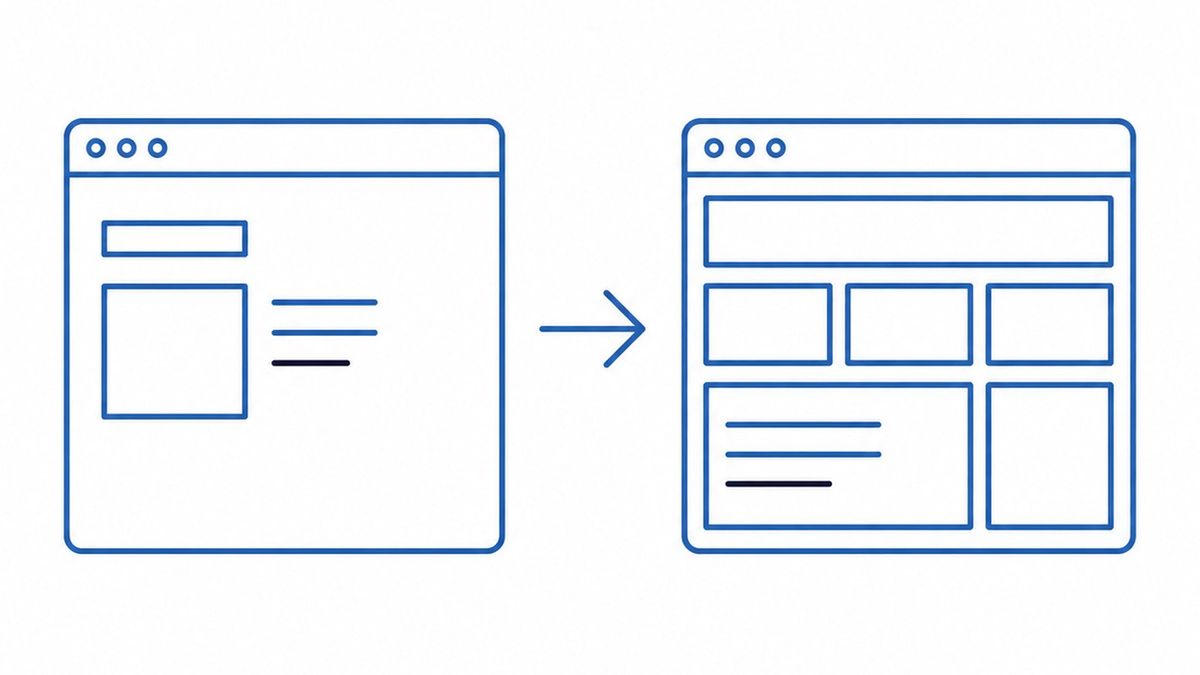
Website Redesign or Rebuild? A Decision Framework for 2026
Whether to rebuild an old website is not an aesthetic judgement but a structural one: an unsupported runtime, no responsive design, or lost admin control mean rebuild, while dated visuals or stale copy usually mean a redesign is cheaper and safer. This guide gives six paired signals, the five mechanisms behind post-launch traffic collapse and how to prevent each, a seven-question decision flow, and the three things to finish before any code is written.