AI Search Engines Compared: Where Exporters Should Start
ChatGPT, Perplexity, Google AI Overviews, and Gemini select sources in genuinely different ways. Here is the mechanics of each, plus a 90-day priority order for lean export teams.
Optimizing for AI sounds like one job. It is four. Ahrefs found 86% of top cited sources are not shared across the major assistants, AI Overviews pull 76% of citations from Google top 10 while ChatGPT pulls about 8%. Here is how each engine picks sources, plus a 90-day priority order.
Contents ▾
For two years now, manufacturers and suppliers have been told the same thing: "optimize for AI." It is good advice wrapped around a dangerous oversimplification, because it treats AI search as one battlefield. It is not. ChatGPT search, Perplexity, Google AI Overviews, and Gemini pull from different indexes, weight freshness differently, and select sources through genuinely different mechanics. The same product specification page can be cited constantly in Perplexity and remain completely invisible in ChatGPT.
That distinction matters most to companies without a large marketing budget. If you cannot do everything, you need to know which engine matters for your buyers and what your next ninety days should target. This article breaks down the mechanics of each of the four engines, gives you a side-by-side comparison table, and ends with a sequenced priority list. It is not another general GEO overview — for that, see our GEO survival guide for export manufacturers. HappyCXO Studio works mostly with mid-sized manufacturers running marketing teams of three people or fewer, and the sequencing below is designed for exactly that constraint.
Why being recommended by AI is four battles, not one
The direct answer: the four major AI search engines draw from source pools that barely overlap. Ahrefs analyzed roughly 76.7 million AI Overviews, 957,000 ChatGPT prompts, and 953,500 Perplexity prompts and found that of the top 50 most-cited websites on each platform, only seven appeared on all three — meaning 86% of the top cited sources are not shared. Winning one engine does not hand you the other three.
That divergence is structural, not random. A separate Ahrefs study of 15,000 long-tail prompts measured how often each engine cites a URL that also ranks in Google top 10 for the same prompt: Google AI Overviews hit 76%, Perplexity 28.6%, Gemini 8.6%, and ChatGPT roughly 8%. Read that the other way around: ranking first in Google is close to decisive for AI Overviews, and worth about one-eighth as much for ChatGPT.
The reason is that each system acquires its evidence differently. Google AI Overviews and AI Mode sit directly on top of Google's own search index, which is why they track organic rankings so tightly. Perplexity retrieves first and generates second, so it favors pages that are fresh, structurally clear, and quick to verify. ChatGPT search blends the Bing index with OpenAI's own OAI-SearchBot crawl plus content licensing deals, which tilts it toward publishers and encyclopedic sources. Gemini uses query fan-out: it decomposes one question into several parallel sub-queries and merges the results.
There is a practical second-order effect here that most suppliers miss. Your buyers are not randomly distributed across the four engines. A design engineer comparing technical specifications tends to use Perplexity because it shows a clickable source list. A sourcing manager screening suppliers with an open question like "who makes X in Taiwan" usually asks ChatGPT. And when that same person checks a standard or a term on a phone, what they see is a Google AI Overview. The engines map to different stages of the buying process, not to different people — and that is the single most useful criterion for setting priorities.
One expectation to set up front: AI search will send you far less raw traffic than organic search does, and that is fine. Statista's ongoing tracking of AI-powered search shows assistant usage growing fast while still representing a minority of total search activity. The reason to invest is not volume, it is quality and timing. Being named as one of three credible suppliers inside a buyer's shortlist conversation is worth more than a thousand low-intent sessions.
ChatGPT search: why the Bing index is your entry ticket
The direct answer: ChatGPT search draws on both the Bing index and OpenAI's own OAI-SearchBot crawl, which makes Bing indexation a real gatekeeper. A supplier website that has never been submitted to Bing Webmaster Tools is structurally handicapped inside ChatGPT — and fixing that takes an afternoon.
Start with the mechanics. OpenAI's official crawler documentation separates the roles: GPTBot collects training data, OAI-SearchBot fetches pages for ChatGPT search, and ChatGPT-User handles live, user-initiated retrieval. All three can be controlled independently in robots.txt — which means the very common decision to "block AI scrapers" often blocks OAI-SearchBot along with the rest, effectively opting the company out of ChatGPT search entirely. It is the single most damaging misconfiguration we find during site audits.
Now the actionable part. HubSpot's guide to getting indexed by ChatGPT surfaces two facts that matter enormously for smaller companies. First, the median time from publication to ChatGPT citation is about 6.81 days across roughly 900 analyzed marketing pages — this is a weekly loop, not a quarterly one. Second, domain authority still moves the needle hard: sites with 350,000+ referring domains averaged 8.4 ChatGPT citations, while sites under 2,500 referring domains averaged 1.6 to 1.8. That second number sounds discouraging, but it actually points at the correct strategy. You will not win on authority, so win on specificity — be the only source that answers a very narrow question completely.
Concretely, four steps. Submit your domain and sitemap to Bing Webmaster Tools for both language versions. Enable the IndexNow protocol so every content update is pushed to Bing and Copilot instead of waiting for a recrawl; at HappyCXO Studio the IndexNow ping is wired directly into the publishing step, which typically puts new pages into the Bing index within hours. Verify that robots.txt explicitly allows OAI-SearchBot. And rewrite the pages you most want cited — capabilities, certifications, capacity, application cases — so each passage stands on its own, because ChatGPT extracts by passage, not by page.
This is where a persistent myth needs killing: "we rank well in Google, so ChatGPT will find us." The Ahrefs number already answered that — only about 8% of ChatGPT citations also rank in Google top 10, and more than 80% come from pages with no organic ranking for that query at all. That is genuinely good news. ChatGPT is the least rank-locked of the four engines, and therefore the most realistic place for a supplier nobody has heard of to break through. The prerequisite is being visible on the Bing side first and structuring your site content so a model can parse it — which is the first layer we address in our website and SEO service.
Perplexity: live retrieval and a strong freshness bias
The direct answer: Perplexity behaves the most like a search engine of the four — it retrieves first, generates second, attaches a clickable source list to every answer, and visibly favors fresh, well-structured, quickly verifiable pages. For manufacturers with real technical content, it offers the best return per hour invested.
Mechanically, Perplexity's crawler documentation describes two distinct agents: PerplexityBot, a conventional crawler that maintains the index and respects robots.txt, and Perplexity-User, a live fetcher triggered by a user's question. That dual design explains a key behavior — Perplexity consumes both indexed history and just-fetched pages, so newly published content can be cited quickly without waiting for a full reindex cycle.
The citation-first philosophy shows up in the product itself. Taiwanese tech outlet iThome's ongoing Perplexity coverage notes that Perplexity's patent search tool is explicitly built citation-first — find the sources, then produce the answer — and that Perplexity was among the first AI search companies to launch a publisher revenue-sharing program. A company that treats source verifiability as the product will naturally prefer pages that put their facts in the open.
The data backs this up. Ahrefs found Perplexity citations rank in Google's top 10 28.6% of the time, roughly three times the rate of ChatGPT or Gemini. Semrush, analyzing 5,000 keywords and over 150,000 citations, likewise found Perplexity showed the strongest alignment with Google's top 10 of any platform studied. The practical translation is blunt: every hour of conventional SEO work converts into Perplexity visibility at a far higher rate than into ChatGPT visibility. If you already have some organic footing, Perplexity is where results appear soonest.
So what do you actually do? Three things. Make facts machine-extractable: specifications in HTML tables, certifications in lists, numbers in text rather than baked into images. (Publishing a full spec sheet as a single JPEG is the most common manufacturing-site mistake there is — to an AI system it simply does not exist.) Signal freshness: put visible published and updated dates on every page and actually maintain them, because Perplexity weights recency far more heavily than the other engines and will skip a product page untouched for three years on any comparison-type question. And answer one clear question per page, with the answer delivered in the first 40 to 60 words rather than after a company-history preamble. The full technical and content checklist is in our B2B manufacturer website SEO checklist.
There is one under-discussed second-order benefit. Perplexity's sources are clickable and displayed alongside the answer, which makes it one of the few engines that reliably sends traffic back to your site. ChatGPT and AI Overviews often satisfy the user without a click, while Perplexity's interface actively encourages verification. For a manufacturer whose credibility depends on buyers actually seeing the factory floor, the production line, and scanned certificates, being able to pull people back to the site matters far more than a bare mention.
Google AI Overviews: an extension of classic SEO, not a replacement
The direct answer: AI Overviews are not a separate battlefield — 76% of their citations come from pages already ranking in the organic top 10. The most effective AI optimization for AI Overviews is doing conventional SEO properly. There is no shortcut and no special file to publish.
Google says this outright. The official Search Central documentation on AI features states that there are no additional requirements to appear in AI Overviews or AI Mode and no special optimizations necessary, and explicitly adds that you do not need to create new machine-readable files, AI text files, or markup. Every recommendation Google gives is classic fundamentals: be indexable, allow crawling, keep important content in text, keep structured data consistent with what is visible, and use internal links so content is discoverable.
The measurements agree. Ahrefs put AI Overviews citation-to-top-10 overlap at 76%. Semrush's AI Mode study found roughly half the cited domains and about a third of cited URLs overlapped with the organic top 10, with the link cluster beneath the answer overlapping close to 90%. Semrush's separate study of 200,000 AI Overviews also shows AI Overviews expanding steadily into commercial-intent queries — directly relevant to exporters, since "best X supplier" and "X manufacturer Taiwan" sit squarely in that band.
Here is the second myth worth killing: "AI Overviews will eat my traffic, so SEO is not worth funding." The first half is true and the conclusion is wrong. AI Overviews do compress click-through on informational queries, but they simultaneously create a new brand-exposure slot. More importantly — if 76% of citations come from the top 10, abandoning SEO forfeits both the organic position and the AI summary slot. The correct response is not retreat but reallocation: shift content weight from generic informational pieces toward decision-stage and specification-comparison content, because that intent survives summarization. A buyer can read the summary and still needs to click through to check your actual capacity and certifications.
In practice, optimizing for AI Overviews means doing three old things thoroughly. Technically, confirm pages render and index fully for Googlebot — JavaScript-heavy sites are the second most common blocker we find in audits. Editorially, make every H2 state its own topic and lead with the answer. Structurally, keep Product, FAQPage, and Organization markup perfectly aligned with visible content. We have collected the how-to pieces on our website SEO topic hub.
Gemini and the query fan-out citation logic
The direct answer: Gemini and Google AI Mode use query fan-out — decomposing one question into multiple parallel sub-queries and merging the results. That mechanic has one dominant implication: content that answers several related sub-questions clearly on the same page gets reused and cited most often.
Search Engine Land's guide to query fan-out explains that most AI search surfaces — AI Overviews, AI Mode, Gemini, ChatGPT, Perplexity, and Copilot — use some form of query expansion. Google's own announcement of AI Mode describes the system issuing multiple related searches across subtopics and data sources while the answer is assembled. The same logic is exposed to developers through Grounding with Google Search in the Gemini API, where the model retrieves live context before generating.
What is interesting is that Gemini's citations do not track Google rankings closely at all. Ahrefs measured only 8.6% overlap with Google's top 10 and a higher 14% overlap with Bing's top 10. So Gemini is clearly not just reading page one of Google — it is re-selecting after the fan-out. For a supplier, the implication is to stop staring at head-term rankings and start covering the sub-questions your buyer's question decomposes into.
Take a concrete example. A buyer asks: "Which Taiwanese manufacturers can produce IP68-rated enclosures for outdoor EV chargers?" That fans out into several sub-queries — what IP68 actually certifies, enclosure material selection for outdoor charging hardware, which Taiwanese manufacturers serve that segment, and certification plus lead-time realities. If your site has one page saying "we make waterproof enclosures," you appear in none of the four. If you have an interlinked cluster covering IP ratings, material selection, certification workflow, and capacity and lead times, you have four chances to be retrieved. That is the real value of a topic cluster in the AI era: not publishing more articles, but covering every facet a question breaks into.
Supporting that requires one underrated piece of groundwork: entity consistency. A model has to be confident that "HappyCXO Studio," "happycxo.com," and "the Taiwan-based AI export marketing agency" all refer to the same entity before it will name you in an answer. That means a consistent company name across the site, Organization structured data, and a clearly defined vocabulary — we maintain our own export and AI marketing glossary as an entity anchor. For how to structure answer-first passages around those entities, see our GEO content strategy piece.
The four-engine comparison table
The direct answer: if you remember one thing from this article, make it this table. It compresses the preceding five sections into the six dimensions a supplier actually needs for a decision: where sources come from, how tightly citations track organic rankings, how much freshness matters, the highest-leverage action, expected time to results, and value for B2B export specifically.
| Dimension | ChatGPT Search | Perplexity | Google AI Overviews | Gemini / AI Mode |
|---|---|---|---|---|
| Primary sources | Bing index + OAI-SearchBot crawl + licensing deals | Own index via PerplexityBot + live Perplexity-User fetch | Google organic search index | Google index + query fan-out sub-queries |
| Citation overlap with Google top 10 | ~8% (lowest) | ~28.6% (highest) | ~76% | ~8.6% (14% with Bing top 10) |
| Freshness weighting | Medium (median 6.81 days publish to citation) | High, clear preference for recently updated pages | Medium, follows organic ranking cadence | Medium, varies by sub-query topic |
| Highest-leverage action | Submit to Bing + IndexNow, allow OAI-SearchBot, self-contained passages | Tabulated specs, visible update dates, answer-first passages | Do classic SEO thoroughly: indexable, text-based, consistent schema | Topic clusters covering sub-questions, entity consistency, internal links |
| Time to visible results | 1–4 weeks once Bing indexation lands | 2–6 weeks, fastest if organic footing exists | 3–6 months, tied to organic ranking growth | 2–4 months, needs cluster accumulation |
| Value for B2B export | High: the shortlist-building stage | High: spec comparison, clickable sources, real referral traffic | Medium-high: brand exposure on term and standard queries | Medium: coverage of long-tail technical sub-questions |
The most important thing in this table is not any single cell — it is the combination of the last two rows. ChatGPT delivers results fastest and is decoupled from existing rankings, which makes it the best entry point for a newcomer. AI Overviews are the slowest and are entirely bound to organic position, which makes them a harvest for companies that already have SEO equity, not a starting line for those that do not. Plenty of consultants recommend starting with AI Overviews; as a resource-allocation decision that is simply backwards, because it requires winning six months of conventional SEO before collecting your first AI ticket.
The freshness row is also easy to misread. It does not mean you must edit the site weekly. It means each engine applies a different test for "does this page still count." Perplexity will skip a three-year-stale page on a comparison query; AI Overviews will keep an older but authoritative page as long as it holds its organic position. The workable compromise is to review specifications, certifications, and capacity figures on core product and capability pages once a quarter, and update everything else as needed.
How a resource-constrained exporter should sequence this
The direct answer: run a two-week elimination pass first, attack ChatGPT and Perplexity in months one and two, and only then invest in the long-compounding AI Overviews and Gemini work from month three. The logic is simple — stop the leaks, then take the fastest-converting battlefield, then fund the compounding asset.
Phase 0 (weeks 1–2): elimination. This phase produces no new content; it only confirms you are not blocking yourself. Check four things: whether robots.txt accidentally blocks OAI-SearchBot and PerplexityBot; whether key pages require JavaScript to reveal their content, which most AI crawlers will not execute; whether specs and numbers are locked inside images and PDFs; and whether both language versions carry correct hreflang and indexable status. These fixes cost almost nothing, but skipping them discounts every content dollar that follows. A first audit typically surfaces two or three structural blockers of exactly this kind.
Phase 1 (weeks 3–8): earn the ChatGPT entry ticket. Submit to Bing Webmaster Tools, wire up IndexNow, and rewrite the 8 to 12 most important pages — capabilities, main product lines, certification list, application cases, and FAQs — into answer-first structure. Why ChatGPT first? Because it is the least correlated with existing rankings, meaning you do not have to win SEO before you can be cited. For a manufacturer with no ranking base, it is the only route with a realistic short-term payoff.
Phase 2 (weeks 5–12, overlapping Phase 1): take Perplexity. Convert specification images into HTML tables, add visible update dates, and build one deep page per main product line covering technical specifications, typical applications, and certifications. Everything produced in this phase simultaneously feeds Google organic ranking, so the investment returns twice.
Phase 3 (from month 3): build topic clusters and harvest AI Overviews and Gemini. Plan content around buyer questions, three to five interlinked pieces per topic, covering definition, standards, selection criteria, comparison, and implementation. This is a compounding asset — flat for the first quarter, visibly productive after that.
Reframing the cost question. Owners usually ask what this costs. The better question is what not doing it costs. Most of the work in Phases 0 through 2 is correcting and rewriting assets you already own, not creating new ones, so the marginal cost is close to zero and the real input is staff hours. Only Phase 3 requires sustained investment. So the honest budget conversation is: spend two months of internal time fixing the foundation, confirm that AI citations start appearing, and only then decide how much external resource Phase 3 deserves.
Two prerequisites for measurement. First, baseline before you start. Record how often you are currently mentioned across the four engines using a fixed set of buyer questions, tested manually once a month. Without that baseline you cannot judge results three months later. Second, accept that attribution will be incomplete. AI-sourced traffic frequently lands in analytics as direct or referral, and "mentioned but not clicked" never appears in any analytics tool at all. Treat AI visibility as a brand metric measured by periodic sampling, not as a traffic metric. When those buyers do write in, the follow-up and outreach workflow is covered by our AI export outreach service.
Three misconceptions worth correcting
The direct answer: most suppliers go wrong on AI search not through weak execution but by accepting three false premises at the start. Correcting these three is usually worth more than publishing ten more articles.
Misconception one: one round of AI optimization covers all four engines. This is what the whole article argues against, and the Ahrefs 86% non-overlap figure settles it. There is a subtler version of the same error, though: "I asked ChatGPT about my company and it answered, so we must be doing fine." That test is invalid. When you name a company, the model is simply retrieving information about that company. The real test is the unnamed buyer question — something like "who are reliable Taiwanese suppliers for industrial connectors?" Whether you appear in that answer is your actual visibility.
Misconception two: ranking first in Google means AI will cite you. Roughly true for AI Overviews at 76%, and false for the other three at 8% to 28.6%. Read in reverse, this also means no ranking does not mean no chance — over 80% of ChatGPT citations come from pages with no organic ranking for the query at all. For a small or mid-sized manufacturer this is the most important structural opening in years: outside the keyword landscape that large competitors dominate, AI search has opened a path where content specificity beats domain authority.
Misconception three: AI search traffic is too small, so it can wait. This conflates volume with timing. AI search volume is indeed far below organic today, but citations take time to accumulate: ChatGPT's median publish-to-citation lag is 6.81 days, while topic clusters take three to six months to mature. Starting once AI search volume becomes impossible to ignore simply gifts competitors another six months of head start. More fundamentally, AI search changes the shortlisting mechanism, not just the traffic source — when a North American buyer asks which three Taiwanese suppliers fit a given specification, that list is the new first screening round, and the companies left off it never learn they were screened out.
One additional observation: internal resistance usually outweighs technical difficulty. The most common blocker we hit is not engineering capability but a sales team convinced that publishing specifications online gives away leverage. That instinct made sense in an earlier export era. Under AI-driven shortlisting it has inverted: withholding specifications does not protect you, it erases you. The workable compromise is tiering — publish the specification ranges and certifications a buyer or model needs to judge that you can do the job, and keep exact tolerances, cost structure, and customization terms for the conversation after the inquiry arrives. That framing usually satisfies the sales team, and it is the part of an engagement that takes the most discussion.
Back to the opening question: which engine should a resource-constrained exporter attack first? Start with ChatGPT, because its entry barrier is technical configuration rather than ranking. Build Perplexity alongside it, because it actually returns traffic. Treat AI Overviews and Gemini as the three-to-six-month compounding harvest. If you want to know which layer your own site is stuck on, talk to us — we start with a four-engine visibility sample before discussing whether to work together at all.
Further reading: Make Your Site Readable to AI: The AEO Technical Setup Guide · North American Buyers Now Use AI to Find Suppliers
FAQ
How do ChatGPT, Perplexity, Google AI Overviews, and Gemini differ in picking sources?
With a small team, which AI engine should an exporter prioritize first?
If I rank first on Google, will AI cite me?
What happens if robots.txt blocks AI crawlers?
Why does Perplexity matter especially for manufacturer websites?
How do I test whether AI search is citing my company?
Does publishing specifications online give away competitive leverage?
References
- 1.86% of Top Mentioned Sources Are Not Shared Across ChatGPT, Perplexity, and AI Overviews— Ahrefs
- 2.Only 12% of AI Cited URLs Rank in Google's Top 10 for the Original Prompt— Ahrefs
- 3.How Google AI Mode Compares to Traditional Search and Other LLMs— Semrush
- 4.AI features and your website— Google Search Central
- 5.How to Get Indexed by ChatGPT— HubSpot
- 6.OpenAI crawlers and user agents— OpenAI
- 7.Perplexity Crawlers— Perplexity
- 8.Query fan-out in AI search: What is it and how does it work?— Search Engine Land
- 9.AI-powered online search — statistics & facts— Statista
- 10.Perplexity 相關報導彙整— iThome
We help small and medium businesses grow export sales in the AI era.
Related articles
Website Health Check: 9 Technical Problems SMEs Miss
Nine technical problems turn up again and again on small-business websites: no GA4, a misspelled ads parameter, the wrong language declaration, multiple H1s, missing alt text, no structured data, long articles with one subheading, unmeasured speed, and shaky HTTPS or mobile basics. You can check all nine yourself with a browser, and most need no rebuild.
How Much Does a Website Cost in 2026? A Quote Decoder for SMEs
A small business website typically costs 2,000 to 15,000 dollars in 2026, with mid-size builds at 15,000 to 60,000. The spread comes down to hours bought, liability carried, and aftercare promised, plus 15 to 25 percent of build cost in annual operating fees. This guide gives you the price table, an eight-item quote checklist with the consequence of leaving each one vague, the common pricing traps, and two three-year total cost of ownership models.
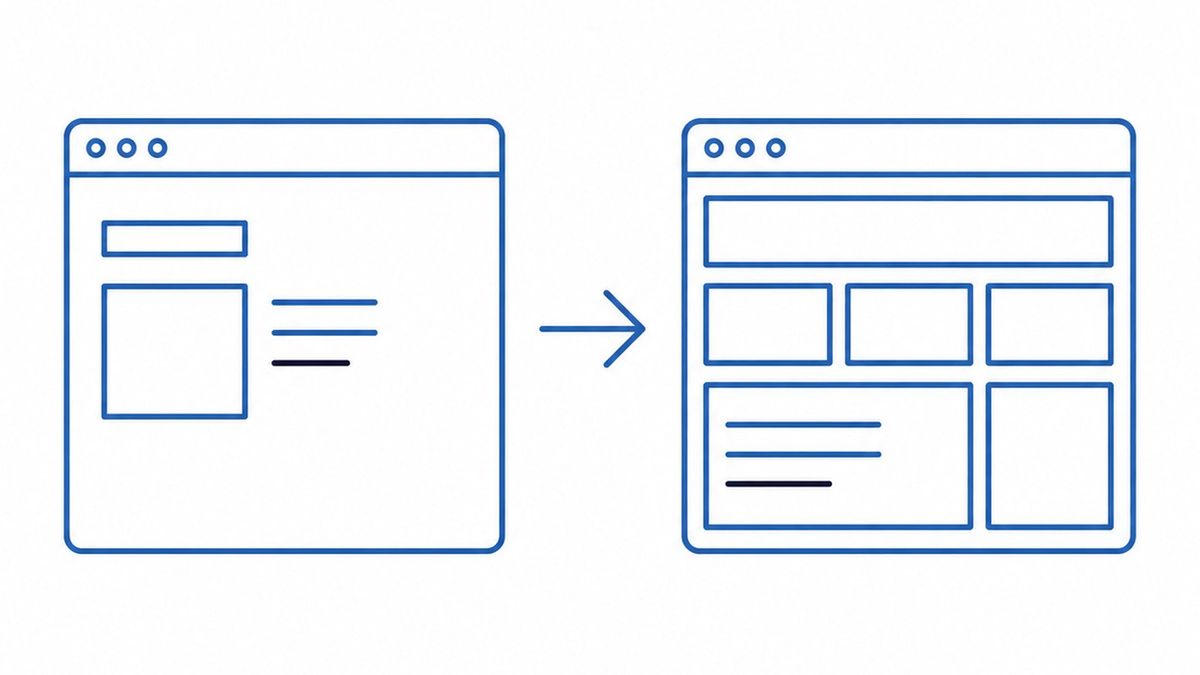
Website Redesign or Rebuild? A Decision Framework for 2026
Whether to rebuild an old website is not an aesthetic judgement but a structural one: an unsupported runtime, no responsive design, or lost admin control mean rebuild, while dated visuals or stale copy usually mean a redesign is cheaper and safer. This guide gives six paired signals, the five mechanisms behind post-launch traffic collapse and how to prevent each, a seven-question decision flow, and the three things to finish before any code is written.