Preparing to Sell Your Business: The Two-Year Plan
Buyers price the last two to three years of your record, not the decision you made this morning. A 24-month pre-sale value-building playbook.
Most owners start preparing on the day they decide to sell, while buyers are reading the previous two to three years — a two-year gap. This is the pre-sale playbook: the six structural issues buyers discount, and a month-by-month 24-month timeline.

Contents ▾
Most owners start preparing to sell on the day they decide to sell. That is the single most expensive mistake in this entire process. A buyer in diligence is not evaluating your resolve today — he is reading the last two to three years of your actual record: who made the decisions, why customers kept reordering, whether the process ever left your head, and whether the numbers reconcile. None of that can be manufactured in ninety days. It can only be built in advance.
Preparing to sell a business is not a sprint. It is a project with a required duration, and twenty-four months is the shortest realistic version of it — short enough that you will not lose patience, long enough for a buyer to see a trend in your data rather than a snapshot. This article covers the six things to do in those twenty-four months, plus a month-by-month timeline for sequencing them.
A word on scope. HappyCXO Studio is a digital export-marketing firm working with Taiwan manufacturers. We are not an M&A intermediary, an accounting firm, or an investment institution, and we take no fee from any transaction. Nothing here is financial, tax, accounting, or legal advice, and it should not be read as such. Anything touching entity structure, equity, tax exposure, employment terms, or contract language belongs to your own CPA and attorney. What we can contribute is the operating view: which things buyers discount you for, and which of those you can genuinely fix in two years.
If you are earlier in the process — what the company is worth, who the buyers are, how a deal actually runs — start with our business succession and sale topic hub.
Why Deciding to Sell Is Already Two Years Too Late
Because buyers price your record, not your promises. Diligence looks backward across two to three years of orders, books, payroll, and process, and those facts have already happened. Once you decide to sell, the only thing left to change is presentation — and discounts come from the facts, not the presentation.
There is an asymmetry most owners never confront. You spent thirty years building the company; the buyer gets roughly three months to decide what it is worth. In that window he cannot absorb your industry instinct. He can only rely on evidence he is able to verify. Anything he cannot check — anything he has to take on your word — gets classified as risk, and in M&A risk does not become a deduction on a scorecard. It becomes price and terms: a lower multiple, a bigger holdback, a longer earnout.
US research shows the preparation gap plainly. The Exit Planning Institute's long-running State of Owner Readiness study found that 75% of owners want to exit within ten years while only 13% have a formal exit plan, and that 78% of Baby Boomer owners have never completed any pre-transition value enhancement work. That is US survey data; Taiwan has no equivalent statistic. But the structure — many owners intending to exit, very few doing anything early — is entirely familiar on the ground here.
Taiwan supplies a different data set. PwC Taiwan's 2025 Global and Taiwan Family Business Survey reports that more than 60% of Taiwan family businesses have a succession plan underway or completed, with 46% passing to children or family and 16% planning to hand over to professional managers — while more than half have no family governance mechanism of any kind. Intent without infrastructure is exactly how owners discover, too late, that they have run out of runway. Taiwan's Central News Agency, covering the same survey, notes that 47% of respondents rank succession among their top five challenges.
The scale is worth putting in context. Taiwan's Ministry of Economic Affairs reports in the 2025 SME White Paper that the country had more than 1.715 million SMEs in 2024, over 98% of all enterprises, employing roughly 9.19 million people with sales above NT$31 trillion. As the founding generation reaches the handover point, the succession question that CommonWealth Magazine has tracked in its long-running series on generational transfer will, for a large share of those companies, resolve as a sale rather than a family handover. And a sale depends far more than a handover does on what happened in the preceding two years.
Worth killing a common belief: "we are profitable, so someone will buy us and the market will set a fair price." Profit is the entry ticket. It determines whether anyone will talk to you, not what they will pay. Price is set by risk, and risk in a small manufacturer is almost entirely structural: what happens when the owner leaves, when the largest customer leaves, when the senior technician retires, when a number cannot be traced. Two equally profitable companies can be valued a full turn apart on those answers alone. For how multiples are actually built, see our piece on SME valuation methods.
The table below maps the six most common reasons buyers discount a small manufacturer against how much of each you can realistically fix inside twenty-four months. It doubles as the map for the rest of this article.
| Reason for the discount | What the buyer actually fears | Fixable in 24 months? | Minimum time required |
|---|---|---|---|
| Owner dependence | Customers and judgment walk out with you | High | 12–18 months before it shows |
| Customer concentration | One departure erases the profit | Medium | 18–24 months (grow the denominator) |
| Process lives in people's heads | He buys the company but not how it runs | High | 12 months for the core |
| Low revenue predictability | Future cash flow cannot be modeled | Medium-high | Needs 24 monthly data points |
| Key-person retention risk | The team dissolves after closing | Medium | Start 12 months out to stay credible |
| Records that do not reconcile | Diligence surprises, delays, or breaks the deal | High | Earlier is better; retrofits are obvious |
The right-hand column is the important one. Most items need more than twelve months, and several require an accumulated record rather than a one-time cleanup. That is why two years is the floor, not a comfortable cushion.
Thing One: Reduce Owner Dependence — the Biggest Discount of All
Owner dependence is the most common and most expensive discount applied to small companies. What frightens a buyer is not that you are capable; it is that your capability cannot be transferred. Customers order because they trust you, quotes clear because of your instinct, suppliers concede because of your relationship. When you leave, all of it resets to zero.
Run an honest self-test that costs nothing. For two consecutive weeks, do not go to the plant, do not take customer calls, do not approve a quote. Then check three things: did any order stall waiting for you, did any customer ask for you by name, was any quote left undecided because nobody else dared? Three yeses mean a large share of what a buyer would be paying for is attached to a person who will not be there in two years.
For some buyer types this is decisive. Stanford GSB's 2026 Search Fund Study tracks 862 core search funds in the US and Canada since 1984, reporting an aggregate 33.9% IRR and 4.75x ROI as of December 31, 2025, with a median acquisition price around US$16 million in recent deals. Note that this is US and Canadian data; Taiwan deal sizes and structures differ and the figures do not transfer directly. The defining feature of this buyer is that he becomes the CEO himself. For someone who intends to run the business personally, "does it survive the owner leaving" is not a valuation input — it is a survival question. He will pay more for a company that runs without you than he will pay a discount for one that cannot.
Three concrete moves, in order of difficulty. First, write the decision rights down: list every call that requires sign-off — discount authority, delivery commitments, purchasing negotiations, quality release, claims and credits, capital spend — and set a threshold and a named decision-maker for each. Second, double-track every important account: each major customer gets a salesperson or engineer permanently on the relationship, visible on the emails and in the meetings, not copied silently. Third, remove yourself from the workflow, starting with the steps that need you least; after each removal, watch for a month, and when something breaks, fix the mechanism rather than taking the task back.
There is a second-order effect people miss. Reducing owner dependence does not only raise the price — it transforms your position at the table. A company that runs without you gives you the ability to walk away, which is the strongest card in any negotiation. The opposite profile, an exhausted owner who needs to sell and whose company cannot function without him, is exactly the counterparty buyers hope to meet. Harvard Business Review, writing on founder succession, frames choosing your successor-owner as a decision that requires a structured process — and structure requires time and options, both of which only early preparation buys.
Expect real psychological resistance, including your own. "The company cannot run without me" is emotionally a proof of being needed. You have to redefine it first: a company that runs without you is not a loss of relevance, it is thirty years of management work finally completed.
Thing Two: Customer Concentration — Do Not Let One Account Set Your Price
Customer concentration is the second most common discount in diligence. When one account carries too much revenue, the buyer's math is blunt: if that customer leaves after closing, what is left? He will not bet on your relationship surviving. He will price the risk into the multiple, the holdback, or an earnout. The fix is not to cut the big customer — it is to grow the denominator.
Understand the arithmetic. Say 40% of revenue comes from one account, contributing an even larger share of gross profit. The buyer asks three questions: is there a written contract, does it contain a change-of-control clause, and how personal is your relationship with their decision-maker? "No contract, change-of-control clause, and their owner has been my friend for thirty years" reads to a buyer as revenue that could vanish at any moment. He will still buy — but he will protect himself structurally, usually by tying a large slice of the price to post-closing performance, which means you keep carrying the risk.
US market data illustrates what a clean risk profile buys you. The 56th edition of the IBBA and M&A Source Market Pulse survey, covering 300 brokers and advisors and 203 closed transactions, reported that 83% of deals above US$5 million drew at least three offers and 18% drew ten or more bids. Again, US data — Taiwan has far fewer active buyers — but the logic holds: price rises when several buyers compete, and the companies that attract several buyers are the ones with clean risk. Concentration is what scares them off one by one.
Inside two years, the work is growing the denominator, not shrinking the numerator. Cutting a large customer damages profit, and falling profit gets discounted too. Three practical paths. Open a channel that is not you. If nearly all new customers arrive through your personal network, trade shows, and referrals, your customer acquisition is also attached to you personally. Building an acquisition channel the company owns — marketplace storefronts and accounts, product pages that can actually be found — takes time to accumulate, which is precisely what a two-year runway is for. That is the work in our cross-border ecommerce operations service: turning platform accounts, listings, reviews, and ad data into assets held by the company and transferable at closing. Break concentration into three dimensions — customer, end-industry, geography, and channel are separate questions and buyers ask them separately. Convert understandings into documents: annual framework agreements, minimum volumes, rolling forecasts. Even loose terms lower the risk rating simply by existing.
Kill another myth: "our big customer is our moat." In operations that has some truth; in a sale it inverts. A moat is something a competitor cannot take. A single large relationship is usually takeable — especially when the relationship is carried by you. Real moats are tooling, certifications, process yield, switching costs, and brand, all of which stay with the company.
Avoid one common tactical error: chasing small orders in the final year to dilute concentration. Buyers see it. A sudden cohort of low-margin, non-repeating customers does not improve the concentration story; it drags gross margin down and makes the buyer suspect you are dressing the numbers. The denominator has to grow slowly and genuinely — another reason the horizon is two years.
Thing Three: Move Process and Knowledge Out of People's Heads and Into Systems
A buyer is not purchasing how well you make money — he is purchasing whether that method transfers. In small manufacturers the largest asset is usually undocumented: how quotes are calculated, which supplier's material is acceptable, how this class of complaint is handled, how the schedule gets built. Knowledge that lives in a head leaves with the head. Moving it into documents and systems is the highest-return work in the whole two years.
Sequence the migration in three layers. The record layer: write the current reality down at minimum cost — quote logic and cost structure, approved and substitute materials, supplier qualification and inspection standards, complaint triage, key process parameters and judgment criteria. Do not aim for polish; aim for "a new hire follows this and the result is close enough." The system layer: put what you wrote into tools people actually use daily — quoting, CRM, inventory, work orders, scheduling. The point is not which software you buy; it is that data is generated as a by-product of daily work rather than backfilled by someone at month end. The external layer: website, product data, inquiry flow, marketplace accounts — the face the company shows the market.
That third layer is the most underrated and has the most direct effect on price, because a buyer will always ask: "without you, where do new customers come from?" If the answer is your personal network, your customer acquisition is not part of what he is buying. If the answer is "our website produces a steady flow of qualified inquiries and we can show you the sources, the keywords, and the conversion rate," it is a transferable asset with evidence attached. That is why we frame export website development as transferability rather than marketing spend: a site with clear structure, content that both search engines and AI answer engines can cite, and a traceable inquiry pipeline converts the owner's personal credibility into the company's institutional credibility. On why the 2026 standard differs from the 2020 one, see should an SME rebuild its website for AI search.
Taiwan's lag on this layer is visible in the data. The same PwC 2025 survey found 61% of family businesses globally see AI as a growth opportunity, against just 13% in Taiwan. For an owner preparing to sell, that cuts both ways. The bad news: an institutional buyer or a search-fund buyer will see the gap and price it. The good news: closing it inside two years is one of the few moves that pushes valuation up rather than merely avoiding a deduction. The same logic applies on the production side — moving scheduling and BOM out of a veteran's notebook and into a system is about turning manufacturing know-how into a company asset, not just efficiency. We covered the full approach in AI production scheduling and BOM management.
One honest warning: do not install systems in order to sell. A buyer can tell the difference between an ERP that has run for three months and one that has run for three years — the first has empty tables, workarounds, and resistant staff. The value is in the accumulated usage record, not the installation. This is one of the most practical arguments for a two-year horizon: year one to implement and absorb the friction, year two to produce clean, continuous, verifiable data, so that at deal time you hold twelve-plus months of real operating history rather than a slide.
Finally, organizational resistance, which is where this most often fails. To the people holding the knowledge, documenting it feels like reducing their own irreplaceability. The veteran who will not write an SOP, the senior salesperson who will not enter account notes, the plant manager who will not log exceptions — that is usually self-protection, not laziness. The answer is not an order, it is a redesigned incentive: make teaching and documenting an explicit part of review and bonus, and say clearly that the company will not need them less afterward. That conversation takes months, and months are what early preparation gives you.
Thing Four: Make Revenue Predictability Visible
A buyer pays for future cash flow, not last year's revenue. So the question is not how much you did, but whether it recurs, how much, and on what basis. Predictable revenue earns a higher multiple — and predictability is not asserted, it is demonstrated with a continuous data series. That is exactly why it takes two years.
McKinsey makes one point repeatedly about valuation multiples: multiples ultimately follow performance rather than industry labels. Within the same sector, companies that consistently deliver stable growth and returns on capital trade meaningfully higher than peers. For a small manufacturer, that consistency is proven by two things: how repeatable the revenue is, and whether you can quantify it.
Build at least three metrics, and they must be monthly, continuous, and never retroactively edited:
- Repeat-purchase share — the percentage of current-period revenue from customers who also ordered last year. This answers, directly, whether the business comes back on its own.
- Customer retention and churn reasons — how many accounts you lost each year, what share of revenue they were, and why they left. A documented churn record reassures a buyer more than no churn record, because it shows you manage it.
- Order-book visibility — how many forward months of capacity and revenue your confirmed backlog covers. For manufacturers this is the single most persuasive predictability metric.
Another myth to kill: "we are build-to-order, we have no recurring revenue, predictability does not apply." Predictability is not subscription. An industrial components plant where 80% of revenue comes from customers of five years or more, with volumes in a stable band and annual framework agreements or rolling forecasts, can be more predictable than a software firm that churns its base annually. The question is whether you have moved that fact from "I know it" to "it can be verified."
Two structural moves belong in the same two years. Document the verbal relationships: annual framework agreements, long-term supply memoranda, quote validity and price adjustment mechanisms. They may add little real protection, but they convert an understanding into something a buyer can assess. Clean up revenue quality: separate one-off projects from repeat business, identify product lines that stopped being profitable, and present related-party transactions and non-operating income separately. That last part touches accounting classification and tax treatment — have your CPA handle it. This article offers no accounting or tax opinion.
A measurement caveat: baseline first, improve second. Owners routinely launch changes in month one and discover at month twenty-four that they cannot show a before-and-after, because no starting number exists. The right order is to define and record the metrics in months one to three, fix the definitions, and never change them again. Buyers assess the credibility of a trend, and a redefined metric erases the trend.
Thing Five: Team Retention and Handover Risk
Buyers ask a blunt question: after closing, who leaves? If the key managers walk within six months, he bought an empty shell. In a small manufacturer, key-person risk usually extends past the owner to the plant manager, the sales lead, and a handful of senior technicians. This has to be handled early — early enough that staff do not read it as "the company is being sold."
Start with an honest key-person inventory. For every person whose departure would cause real damage, answer four questions: what do they hold (customer relationships, process judgment, suppliers, systems)? Is there a second person who can do it? Are their pay and career path good enough that they want to stay? And is anything between them and the company in writing? Most owners finish this exercise with more key people and less backup than they assumed.
Second, build backup before you try to lock anyone in. The methods are unglamorous: two people on every important account, at least two people able to run each critical process, system and account credentials never held by one person only, and no supplier relationship that recognizes just one face. None of this is hard; all of it needs several months of real operation to count.
Third — and only third — comes retention design, and this step belongs to professionals. The enforceability and compensation requirements of non-compete clauses, the payment conditions and tax treatment of retention bonuses, equity or profit-sharing structures, changes to employment contracts and employee rights are all regulated and highly fact-specific. Have your attorney and CPA design this for your actual situation. This article provides no legal or tax advice. The only operating point worth making here is commonsense: retention arrangements produced at the last minute tell employees the company is being sold, which triggers exactly the instability you were trying to prevent.
Why two years? Because retention has a timing paradox. Say it too early and people worry; say it too late and people feel used. The practical split is to spend the first eighteen months on purely institutional work — job descriptions, review cycles, pay bands, and a succession bench — all of which stands on its own as management improvement and requires no mention of a sale. Only in the final six months, under NDA and with advisors, do you discuss specific post-closing arrangements with a small number of key people.
Weighting differs by buyer type. A strategic buyer in your industry may plan to consolidate overlapping functions anyway, so retention matters less to him (and far more to your staff). A searcher or an investor who intends to run the company personally is buying the team, because he does not know your process. Deciding early who you want the buyer to be therefore changes how much you invest in this item.
Thing Six: Records and Verifiability (Not Accounting Treatment — Just "Can It Be Traced")
This section deliberately avoids accounting treatment and tax planning — that is your CPA's domain, and anything you read in an online article may not apply to your case. The only question here is operational: can the same fact be found in more than one place, and do those places agree? That is what diligence actually tests, and it is where the largest number of deals run aground.
Diligence rests on three-way verification: books, documents, cash. A unit of revenue that appears in the ledger, has a matching order and delivery receipt, and has a matching bank deposit — with amounts and dates that agree — is verifiable revenue. When the three do not reconcile, or one simply does not exist (verbal orders, no signed delivery, payments mixed into a personal account), the buyer will not debate it with you. He will discount the credibility of that revenue or demand a larger holdback.
So the goal for this section over two years is specific: make the last twenty-four months a clean contemporaneous record rather than a retrofit. Retrofits are obvious to professional buyers — a batch of contracts all created the same day, delivery receipts in identical handwriting, system timestamps clustered on one weekend. Doing each entry correctly from today is cheaper than reconstructing later.
The list below covers what is most often requested and most often missing; build it in year one and maintain it: customer contracts and order records including change-of-control clauses, receivables aging and reconciliation, inventory counts and obsolescence handling, equipment and tooling registers with ownership and location, IP and trademark status, facility leases or land-use documents, payroll and overtime records, validity of environmental and fire-safety permits, and a complete schedule of related-party transactions. That last item is near-universal in family businesses and near-always needs professional handling — tell your CPA early.
"Traceable" is not the same as "we have it." A document in the owner's drawer is "we have it." A record in a system, with a creation timestamp, an identified author, and the ability to be pulled independently, is traceable. A buyer's advisors must verify a large volume of facts in limited time, and they weight traceable records far above assertions. This is where the systems work from Thing Three pays a second dividend: when daily operations already run inside systems, the diligence data set exists as a by-product rather than as two months of overtime.
To restate the boundary: entity structure, equity arrangements, tax exposure, and the form and timing of consideration all belong to your CPA and attorney — and they belong there before you sign anything, not after. This article takes no position on them. For the stages and timeline of the transaction itself, see our walkthrough of the business sale process.
The 24-Month Timeline: Months 1–6 / 7–12 / 13–18 / 19–24
Two years is not the six items spread evenly — it is a sequence. The first six months establish baselines and inventory. Months 7–12 make the structural changes. Months 13–18 let those changes accumulate into verifiable data. Only the final six months are actual deal preparation. Invert the order and you will discover, at the moment you most need data, that its starting point does not exist.
| Period | Focus | Key actions | Verifiable output | Most common failure |
|---|---|---|---|---|
| Months 1–6 | Baseline and inventory | Start the three monthly revenue metrics; run the key-person and key-knowledge inventory; run the two-week owner-absence test; assemble contract, equipment, IP, and permit registers | A current-state assessment plus a metric definition sheet (definitions frozen from here) | Improving before measuring, leaving no before-and-after at month 24 |
| Months 7–12 | Structural change | Put the decision-rights table into real use; implement or clean up quoting, CRM, inventory, and scheduling systems; launch an acquisition channel independent of the owner; double-track major accounts | Systems generating daily data; first attributable inquiries from the new channel | Systems installed but unused; the owner delegates verbally while still approving every quote |
| Months 13–18 | Let the data accumulate | Keep running without resets; convert verbal relationships into annual agreements; grow the customer denominator; complete two-person backup on critical processes; institutionalize roles, reviews, and the succession bench | Twelve-plus months of continuous, unedited operating data; concentration visibly trending down | Switching systems or redefining a metric mid-stream, which zeroes the trend line |
| Months 19–24 | Deal preparation | Assemble the advisory team (M&A attorney, CPA, financial advisor); run sell-side self-diligence; build the data room; handle key-person retention under NDA; set your own price and terms floor | A data room that survives the buyer's advisors; a defined walk-away point and negotiation script | Hiring advisors too late; last-minute retention offers destabilizing staff |
A few sequencing principles deserve to be said outright. Measurement precedes improvement — it sounds obvious and it is the most frequently skipped step, and the cost only appears twenty-four months later. Systems precede data, because the data is a by-product; if you intend to implement anything, earlier is strictly better, and installing in year two leaves the record too short. Advisors precede the data room — owners routinely organize everything themselves first, then learn that buyers ask for something else entirely.
If you have twelve months rather than twenty-four, re-prioritize. Concentrate on Thing Three (systems) and Thing Six (verifiability), because those improve fastest. Get owner dependence to the minimum viable version: a decision-rights table plus double-tracked major accounts. Customer concentration will not move materially in a year, so rather than forcing it, disclose it honestly and prepare the explanation — buyers rate a seller who knows his weakness and is working on it far above one pretending it does not exist. With six months, put everything into completeness and consistency of records and into choosing the right advisory team, and make no last-minute move that would make a number look strange.
One more point that rarely gets said out loud: every one of these two years' worth of work is correct even if you never sell. Lower owner dependence lets you take a holiday. Diversified customers let you sleep. Systems mean you stop firefighting. Clean records mean fewer audit headaches. Team backup means you can afford to get sick. Preparing to sell and simply running a good company overlap almost completely — the difference is that a sale forces you to finish them by a date.
Disclaimer: This article shares an operating-management perspective and does not constitute, and should not be treated as, financial, investment, accounting, tax, or legal advice. Selling a company involves corporate law, tax law, employment regulation, and personal financial planning. Any actual decision must be made on advice from a licensed CPA, attorney, and financial advisor working from your specific circumstances, and that advice must be in place before you sign anything. HappyCXO Studio does not provide these services and takes no fee from any transaction.
If the part you want to work on is Thing Three — moving customer acquisition and operations off the owner and onto assets the company can actually transfer — talk to us. We build export websites, content, and cross-border platform operations. We do not touch the transaction itself, but getting this part right makes every later negotiation easier.
FAQ
How far ahead should I prepare to sell, and is two years really necessary?
I have not decided to sell. Is this work wasted?
What does reducing owner dependence look like in practice?
My largest customer is 40% of revenue. Do I have to reduce that?
If I implement systems just before selling, will the buyer notice?
Is this financial or legal advice, and who should I consult?
References
- 1.State of Owner Readiness — 2025 Generational National Report (US data)— Exit Planning Institute
- 2.2025 全球暨台灣家族企業調查報告— 資誠 PwC Taiwan
- 3.資誠2025全球暨台灣家族企業調查:建構家族治理框架 打造永續傳承藍圖— 中央社
- 4.2026 Search Fund Study: Selected Observations (US and Canada data)— Stanford Graduate School of Business
- 5.The Market Pulse Survey Q1 2026 — Trends in Business Sales up to $50M (US data)— IBBA / M&A Source
- 6.The Founder’s Final Act— Harvard Business Review
- 7.How to Make Selling Your Business a Fulfilling Experience— Harvard Business Review
- 8.The right role for multiples in valuation— McKinsey & Company
- 9.《2025中小企業白皮書》發布 中小企業扮演臺灣經濟發展關鍵角色— 經濟部
- 10.百年傳承——接班布局新攻略— 天下雜誌
We help small and medium businesses grow export sales in the AI era.
Related articles
Website Health Check: 9 Technical Problems SMEs Miss
Nine technical problems turn up again and again on small-business websites: no GA4, a misspelled ads parameter, the wrong language declaration, multiple H1s, missing alt text, no structured data, long articles with one subheading, unmeasured speed, and shaky HTTPS or mobile basics. You can check all nine yourself with a browser, and most need no rebuild.
How Much Does a Website Cost in 2026? A Quote Decoder for SMEs
A small business website typically costs 2,000 to 15,000 dollars in 2026, with mid-size builds at 15,000 to 60,000. The spread comes down to hours bought, liability carried, and aftercare promised, plus 15 to 25 percent of build cost in annual operating fees. This guide gives you the price table, an eight-item quote checklist with the consequence of leaving each one vague, the common pricing traps, and two three-year total cost of ownership models.
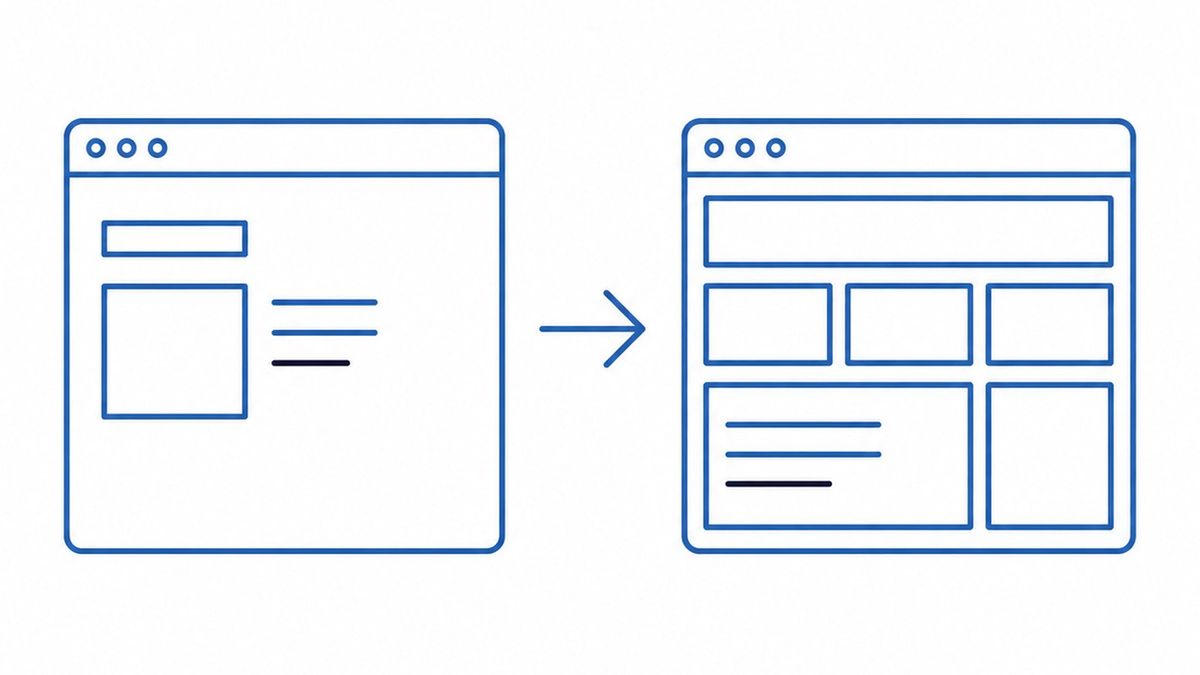
Website Redesign or Rebuild? A Decision Framework for 2026
Whether to rebuild an old website is not an aesthetic judgement but a structural one: an unsupported runtime, no responsive design, or lost admin control mean rebuild, while dated visuals or stale copy usually mean a redesign is cheaper and safer. This guide gives six paired signals, the five mechanisms behind post-launch traffic collapse and how to prevent each, a seven-question decision flow, and the three things to finish before any code is written.